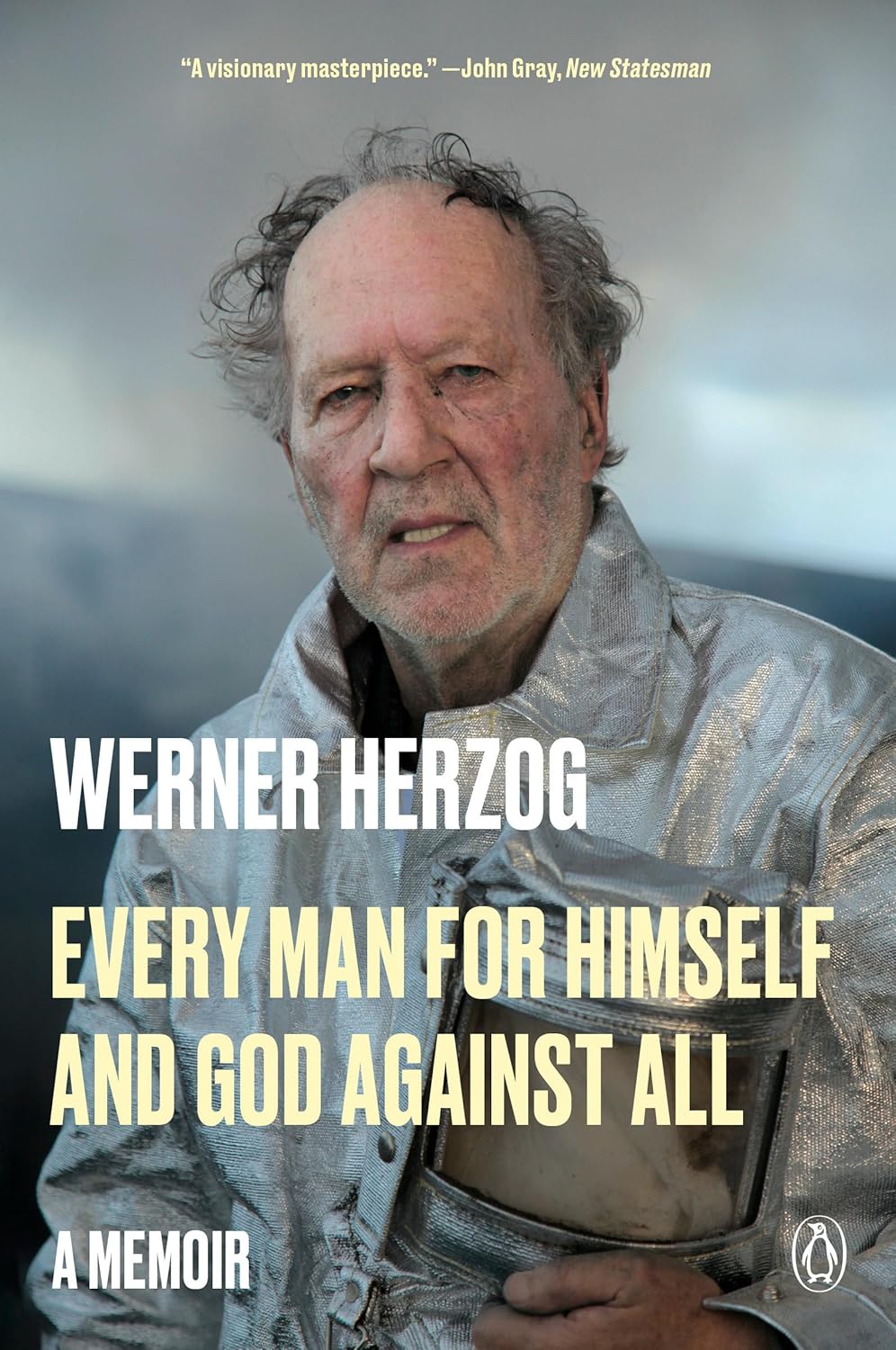
I saved Werner Herzog’s memoir for a year, until I would have time on vacation to thoroughly enjoy the madness, humor, weird asides, extraordinary feats, the complete, willful lack of self-examination, and, ultimately, the graceful intensity of the writing.
Herzog broke one of my cardinal rules of memoir writing. Lying on the beach, I had to admit that he was right.
The book is titled (for no reason) Every Man for Himself and God Against All.
Herzog’s life began in rural poverty during World War II, in the mountains of Bavaria, but he became one of the world’s most interesting and influential film directors, and something of a pop-culture star, with his voice-of-doom, German-accented voice.
The most important element to the success of any memoir is the life it describes. Herzog lived his full throttle, taking every crazy chance, making every extravagant gesture, and risking everything, over and over again.
As an example, he decided to make a film about a mad would-be rubber baron dragging a riverboat over a South American mountain. Hollywood wanted to depict this folly with models and special effects. Herzog insisted on reality: he built a riverboat and hauled it over a mountain. He was just as nuts as the fictional guy he was trying to depict.
Any competent writer could assemble an amusing book from these elements simply by telling the stories in the order they happened. But that’s too obvious for Herzog. He breaks his rough chronology with chaotic abandon, inserting stories, memories, impressions and characters without regard to when they appeared in his life.
This is the rule violation I mentioned. I work with many inexperienced writers. I always tell them chronology is your friend. Time organizes cause and effect for you. If you stick to the order things happen, it’s almost always easier for you and for the reader.
As a young writer, I often experimented with telling stories in non-chronological ways—backwards, jumping around thematically, looking for different ways a reader could appreciate meaning.
In hindsight, a lot of that was ego. Why should I have to do it the way everyone else does? (Answer: because that way works best.)
Herzog doesn’t worry about why he does anything. He contends in his memoir that psychology, by shining light into all the mysterious places in our souls, destroys creativity and makes life unbearable (his constant hyperbole is also part of his charm).
Incidents, memories, and observation pop up in the text wherever Herzog’s volcanic imagination spewed them. And it works: you’re in his life, swirling.
Even in the hands of a master such as Herzog, however, the difficulty of this approach shows up in the later chapters. Left with a bunch of odds and ends that he hasn’t included anywhere, he gives us some later sections that read like lists.
And then the book ends, mid-sentence. Apparently, Herzog was distracted by a hummingbird and decided not to write any more. Perfect.
Chronology may be overrated. But to discard it, you may need to be as brilliant and fearless as Werner Herzog.
If you enjoy my newsletter, please share it.