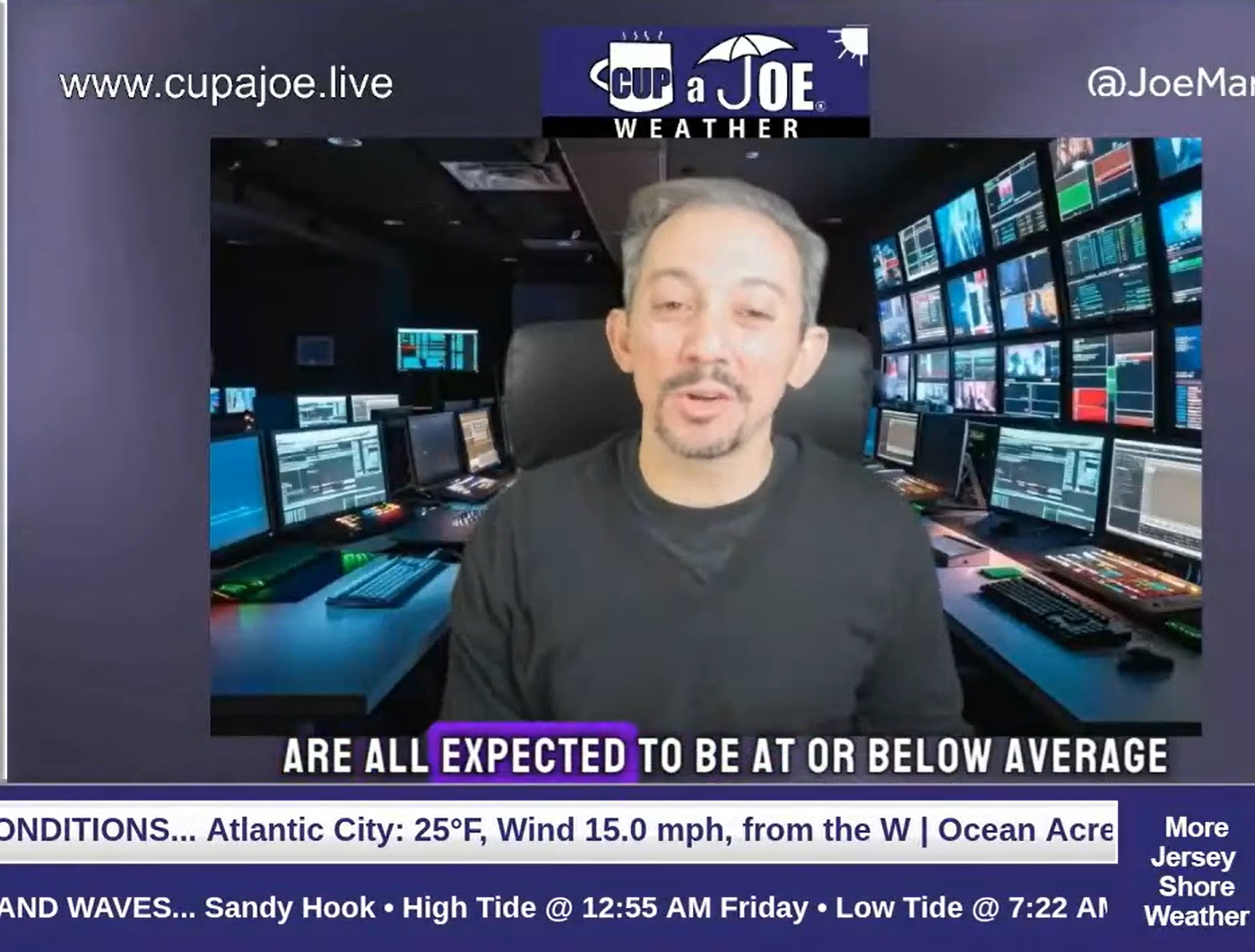
The cheerful weather forecaster in front of a green screen—if you can’t trust that guy, who can you trust? But the temptation to seek clicks has infected even the weather with sensationalism and lost credibility.
Now my friend Joe Martucci, who exudes New Jersey hustle and humor in his forecasts, is taking on the fakers who tell you a big storm is coming when it is not.
I met Joe when we worked together on stories for a partnership journalism program pairing science writers with local reporters to improve coverage of climate change—he was at the Press of Atlantic City and I was freelancing with Climate Central, in Princeton.
True to the times, his publisher laid off his entire team, part of the rapid dismantling of local news all over the country. And Climate Central abandoned partnership journalism, although the organization remains robust in its other science communications.
But Joe didn’t give up (neither did I). He started a new company, Cup a Joe Weather and Drone, and he is making a profit as an independent forecaster and consultant covering the Jersey Shore.
As traditional local news sources collapse nationally, this is a common story. Former news media employees start their own small online businesses or non-profits.
Joe kept his professional role as Chair of Digital Meteorologists for the American Meteorological Society, which certifies meteorologists and issues best practices. Recently, as forecast exaggerations increased in 2025, the group began contacting social media companies to take them down.
The cheaters (as I call them) point to hazy, far-future or low-probability weather model outputs and report them as real coming crises. They predict a deluge when science says scattered showers are most likely, or turn a probable dusting into the possibility of a paralyzing blizzard.
“This kind of hype is irresponsible,” Joe told his colleagues. “It causes unnecessary panic, wastes people’s time and money, and makes the public distrust real warnings when they matter most.”
One of Joe’s readers noted how these exaggerations had hurt his small marine business over the last year—he hadn’t understood the source of the bad information. The weather cheats also hurt honest forecasters, whose less dramatic but more accurate videos get fewer clicks.
Exaggeration is an ethical hazard for every journalist, and if you don’t learn to rein it in early, it can lead to professional disgrace. Older editors pulled me back as a young reporter and taught by example that accuracy is bedrock. Without it, nothing stands.
But I came up in newsrooms that taught the craft. As local journalism dies, those apprenticeships are disappearing. More writers today post their stuff without any editor seeing it.
Joe recalled a Philadelphia TV meteorologist fired many years ago for an egregiously wrong forecast. If you’re posting weather on social media, there’s no one to fire you—and you can make more money by creating hysteria.
Social media offers incentives for bad journalism. Joe Martucci is pushing back by doing the job right, and by setting standards through his professional organization. I’m glad there’s still a positive, scrapy guy doing this honest work.
If you enjoy my newsletter, please share it.